This blog is actually an update of the extensive article on the Belgian mare, Sespe Violette, from Kristina Lucas Francis' wonderful blog, Muddy Hoofprints.
Hagen-Renaker collectors have often wondered about and tried to identify the actual live horse that Maureen Love sketched and sculpted for Hagen-Renaker Potteries and that was released by them in 1954 as Sespe Violette.
Her sire was Sespe Rowdy Junior 19959, he by Rowdy II 10570 out of Burge de Maeter 16492.
Rowdy II 10570, was by Baron de Chaussee 7584 (78644), out of Valdia de Keyem 1768 (67549 Brussels) who was foaled May 29, 1909.
Burge de Maeter 16492, was by Lucifer de Maeter 7276 (Vol.XIX,p.1884), out of Bru? 6736.
Sespe Violette's dam was Nancy Crotti Brown 19287, she by Dr. Crotti 14118, out of Betsy de Hemel 12715.
Dr. Crotti 14118, was by Walthar 8489 (91442), out of Violette's Last 8757.
Betsy De Hemel 12715, was by Distinction de Hemel 12957, out of Betty B. 11088.
Hagen-Renaker collectors have often wondered about and tried to identify the actual live horse that Maureen Love sketched and sculpted for Hagen-Renaker Potteries and that was released by them in 1954 as Sespe Violette.
Sespe Violette
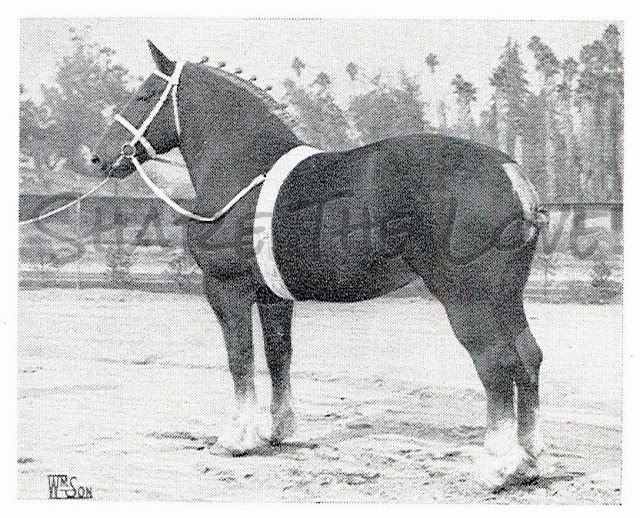

Photo of Sespe Violette courtesy of James Richendollar.
The 'real' Belgian mare, Sespe Violette 32116,
foaled May 11, 1944, was first owned by Rancho Sespe in Fillmore, CA. She was 8 months old at her registry date of January 17, 1945, and described as dark sorrel, star in forehead, light short stripe below eyes, black feet, light mane and tail.Her sire was Sespe Rowdy Junior 19959, he by Rowdy II 10570 out of Burge de Maeter 16492.
Rowdy II 10570, was by Baron de Chaussee 7584 (78644), out of Valdia de Keyem 1768 (67549 Brussels) who was foaled May 29, 1909.
Burge de Maeter 16492, was by Lucifer de Maeter 7276 (Vol.XIX,p.1884), out of Bru? 6736.
Sespe Violette's dam was Nancy Crotti Brown 19287, she by Dr. Crotti 14118, out of Betsy de Hemel 12715.
Dr. Crotti 14118, was by Walthar 8489 (91442), out of Violette's Last 8757.
Betsy De Hemel 12715, was by Distinction de Hemel 12957, out of Betty B. 11088.
Photo of Sespe Violette's registry card courtesy of James Richendollar.


Photo of Lucifer de Maeter courtesy of James Richendollar.
Owners of the 4,000 acre Rancho Sespe were Eudora and Keith Spalding, heir to the Spalding family of baseball and sporting goods fame. Sespe is the name given to the area in the Santa Clara Valley of Ventura County near modern day Fillmore, California, by indigenous inhabitants allegedly of that name. The ranch was the largest in California, purchased by M. B. Hull in 1888 and inherited in 1895 by his son and daughter Eudora Hull Spalding, wife of Keith Spalding. Along with serving as the head of several industrial corporations Keith Spalding was one of the most prosperous and successful agribusiness men in Ventura County. Influenced by the Progressive and Country Live Movements, Keith turned Rancho Sespe into one of the largest private producers of citrus in the country and a model scientific operation.
Early on in his life he was manager of his father's horse ranch in San Diego where he bred Kentucky gaited saddle horses until 1905, and in 1909 started to manage the Sespe Ranch. They were enthusiastic animal lovers, kept many exotic animals and had an extensive rare bird collection. They did experiments using draft horses to work the land, and may be why the Belgians were bred there. When Eudora Spalding died in 1942 she bequeathed the property to Caltech in Pasadena, which used it for agricultural experiments, with her husband a trustee of her estate. Since Sespe Violette was born in May, 1944, could she have been bred in collaboration with Caltech? In researching this it is very interesting that the Kellogg ranch grant to Caltech is heavily mentioned, but the Rancho Sespe gift is not mentioned at all. An intriguing area for more research...

Early on in his life he was manager of his father's horse ranch in San Diego where he bred Kentucky gaited saddle horses until 1905, and in 1909 started to manage the Sespe Ranch. They were enthusiastic animal lovers, kept many exotic animals and had an extensive rare bird collection. They did experiments using draft horses to work the land, and may be why the Belgians were bred there. When Eudora Spalding died in 1942 she bequeathed the property to Caltech in Pasadena, which used it for agricultural experiments, with her husband a trustee of her estate. Since Sespe Violette was born in May, 1944, could she have been bred in collaboration with Caltech? In researching this it is very interesting that the Kellogg ranch grant to Caltech is heavily mentioned, but the Rancho Sespe gift is not mentioned at all. An intriguing area for more research...

Photo courtesy of James Richendollar.
Sespe Violette was sold around 1948-9 to Dewey Hobson Burden, another fascinating man, who started the Owl Trucking Company in Compton, CA
in 1919, owned Rancho Jo-Nita and raced a string of thoroughbred horses
maintaining a thoroughbred breeding farm, Rancho Tecolote, at Buellton,
CA. He is most known for selling Emperor Hirohito of Japan the white
horse the Emperor was often pictured riding during WWII that was
actually a cow pony Dewey found.


Dewey owned the team of Belgians at the Santa Anita and Hollywood Park race tracks used to draw the starting gate into position between races and to harrow the track. The gate had to be hauled from the track to the infield after each start on the main track. It was feared that a tractor might stall, leaving the gate on the track as they came into the stretch and of piling up a field of horses. He sold his prize team of enormous Belgians, Don and Leo, the wheel horses of the eight-team hitch for seven years, to Rillito Park in Tucson, AZ in 1953 and bought an even larger pair in 1956. Dewey Burden died in 1958 and his estate was sold in 1967.

It is likely that Maureen drew Sespe Violette at the Santa Anita race track around 1953. Kristina mentions Sespe Violette as being in the ownership of Kellogg Ranch at Pomona in 1960, so perhaps she was sold, donated or loaned to them after Dewey's death, before her last recorded sale in 1961. After all, she had originally been bred during the time Rancho Sespe was donated to Caltech where the Kellogg Ranch was located.


Dewey owned the team of Belgians at the Santa Anita and Hollywood Park race tracks used to draw the starting gate into position between races and to harrow the track. The gate had to be hauled from the track to the infield after each start on the main track. It was feared that a tractor might stall, leaving the gate on the track as they came into the stretch and of piling up a field of horses. He sold his prize team of enormous Belgians, Don and Leo, the wheel horses of the eight-team hitch for seven years, to Rillito Park in Tucson, AZ in 1953 and bought an even larger pair in 1956. Dewey Burden died in 1958 and his estate was sold in 1967.

Photo courtesy of James Richendollar.
It is likely that Maureen drew Sespe Violette at the Santa Anita race track around 1953. Kristina mentions Sespe Violette as being in the ownership of Kellogg Ranch at Pomona in 1960, so perhaps she was sold, donated or loaned to them after Dewey's death, before her last recorded sale in 1961. After all, she had originally been bred during the time Rancho Sespe was donated to Caltech where the Kellogg Ranch was located.

Photo courtesy of James Richendollar.
Dewey Burden's Belgian 8 horse hitch exhibited at the August 1960 Sheriff's Rodeo in the Los Angeles Memorial Coliseum, produced by Montie Montana. They were mentioned as being owned by Dewey's son Joseph L. Burden of Owl Trucking Co. of Compton and driven by Harry Ogden. Sespe Violette may have been there, as her last known sale was in 1961 to Darrell and Jan Livesay of Clinchport, VA.
Photo courtesy of James Richendollar.
There are postcards that appear occasionally of the 8 horse Belgian team driven by Howard Long, the trainer of the Owl stable, or by Harry Ogden. Sespe Violette may be in those photos, but her distinctive face marking would be the only way to perhaps verify that.
Dewey Hobson Burden's Belgian Horses

Photo courtesy of CynthiaMH4, Ancestry.com
Sespe Violette's sister was Sespe Suzette 30726, also owned by Dewey. They were both used in his 8 horse hitch which was shown in at least 7 fairs and was in the ring 52 times, winning 37 firsts, 11 seconds and 4 thirds. They appeared at the Santa Barbara Fair and Horse Show, Santa Barbara County Fair, San Joaquin County Fair and Fresno County Fair, among others.


Side note - Dewey also owned the team of four high stepping Hackneys which transported the judges to and from their posts and around the track before the first race and between the others in a tooling English Brake at Santa Anita track in the 1940s and leased them during the winter season to the Los Angeles Turf Club. Jimmie Booth, an actor who appeared in The Rifleman series, at some time drove the team of four Belgians and the fancy carriage pulled by the team of four high stepping Hackneys at the track. The veteran leather worker in Pomona, Z. C. Ellis, made the harness work for the Belgians, Hackneys, and association horses at Santa Anita. The Scotch housings worn by the big work horses owned by Dewey Burden and managed by Harry Ogden are Ellis' handiwork.
Dewey Hobson Burden driving his Hackney Ponies

Photo courtesy of CynthiaMH Ancestry.com
The
Hackney pony Brookside Stella, her name known to Hagen-Renaker
collectors but unknown if she was, indeed, the horse Maureen actually
sketched, was owned by Mrs. J. A. Smith of North Hollywood in 1955, a
noted Hackney breeder. Perhaps she had also been owned by Dewey and used at the race track around 1953 when Maureen was there drawing the racehorses and Belgians?
I have transcribed this beautifully written newspaper article about Dewey's hackneys which was published March 8, 1946 in the Burlington Daily Times News, as well as several other papers across the country. Because the draft horses at the track were very well known I was tickled to find any information on the hackney ponies.
I have transcribed this beautifully written newspaper article about Dewey's hackneys which was published March 8, 1946 in the Burlington Daily Times News, as well as several other papers across the country. Because the draft horses at the track were very well known I was tickled to find any information on the hackney ponies.

~~~
Hackneys Tooling English Brake Add Romantic Touch
to Racing at Picturesque Santa Anita
in Shadows of Sierra Madres
to Racing at Picturesque Santa Anita
in Shadows of Sierra Madres
by Ned Brown, NEA Staff Correspondent - Arcadia, Calif., March 16 - (NEA)
This is a beautiful spot, all right, this Santa Anita park in the purple shadow of the majestic Sierra Madres. And it's overrun with beautiful thoroughbreds, representing the bluest blooded equines in America. Although these gorgeous animals strive for the richest stakes ever the broad track in this poetically named town, they are not the only attraction for the visitor. The magnificently landscaped walks, picturesque gardens comprising more than 3,000,000 brilliantly colored plants form a spectacle to delight the eye.
But the elite racers are not the only oat-burners here. There's another horse department that is seldom, if ever, visited by the turf fan, majority of whom find more hectic interest in the mechanical adjuncts of the track - the paramutuel machines.
The hackney pony department is a neat, roomy barn presided over by Dewey H. Burden, of Compton, who leases his hackneys for the winter season to the Los Angeles Turf club.
Every racing afternoon these hackneys jauntily tool an English brake around the track before the first race and between the others. Harness brass-work shining in the sunlight, the compact ponies' coats glistening, their dainty high-stepping feet moving rhythmically, the coachman in his spotless livery and gray topper, red wheels spinning, this four-in-hand turnout cuts a dash and charm reminiscent of bygone, romantic days.
They might be bowling along through an old English countryside, and bring up visions of a roadside tavern and a spot of ale. Actually they are used in carrying the judges around the track to their various patrol stands, and a very snappy and efficient job they make of it.
Both the four-in-hand which pulls the brake and the pair that draws the smaller hunting cart, average some 15 miles per afternoon, and they do it at a spanking trot, never once getting out of step.
There are nine hackney ponies stabled at the track and they are in charge of Harry Ogden, a "whip" of note, who handles the ribbons and supervises the care of equipment and the horses. Harry, a slender, dappr chappie with dignified mien and gray hair, well remembers the old days when he used to take four-in-hand road coaches from Los Angeles out to Baldwin's hotel in Arcadia for dinner and drive back to the city through the moonlight, so he's no green hand at tooling a team.
"There's a lot of work goes into that daily show we put on," Ogden will
tell you. "We start getting ready every morning at five and are not
hooked up and ready to go till noon. All the harness has to be cleaned
and polished, wagons washed, horses' manes and tails braided with
colored yarn - a tough job in itself. When we get through the braiding,
we put roses in it. The ponies have to be specially shod so as to
coordinate their action. That's how you get that rhythmic
high-stepping. They're born high-steppers and are all show stock, have
won prizes up and down the Pacific coast."
Then Harry Ogden let us in on a secret. On Saturday, March 16, when
the meeting closes with the $50,000 San Juan Capistrano Handicap
featured, he's going to drive six hackneys to the brake, something
rarely seen.
Our gray topper off to 'em even though half the patrons don't give these picturesque hackneys a tumble.
A few more breaks like an English brake on the open road and the world might be better and safer.
~~~
Dewey Burden Hackney Ponies at Santa Anita Race Track


